
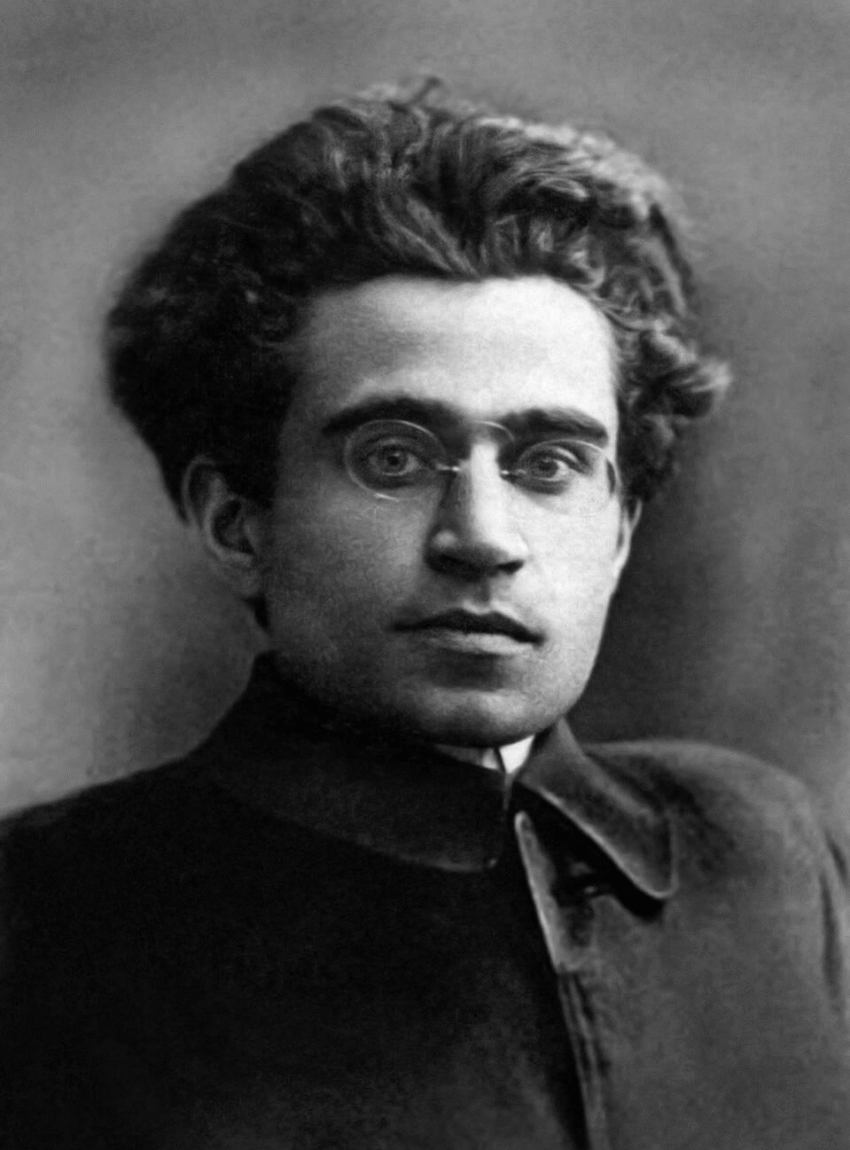
Antonio Gramsci (1891–1937) was a founding member and leader of the Italian Communist Party. Imprisoned by Benito Mussolini’s fascist regime in 1926, he spent his final years in harsh prison conditions, where he authored the influential Prison Notebooks—thousands of pages of political theory, strategy, and cultural analysis.
While Gramsci did not live to see his ideas fully implemented, his writings provided a sophisticated strategy for achieving Marxist revolution in advanced Western societies where direct economic upheaval (as Marx and Lenin envisioned) had largely failed. He emphasized capturing cultural hegemony—dominating the institutions that shape hearts, minds, and values—rather than relying solely on violent overthrow or economic collapse.
Gramsci’s Enduring Influence
American leftists and cultural Marxists have followed this approach with remarkable consistency. They methodically gained influence over key institutions: academia, mainstream media, entertainment, public education, churches, and major political parties. The goal was never just electoral power but a deeper transformation of the culture itself.
This “long march through the institutions” (a phrase inspired by Gramsci’s concepts of “war of position,” though popularized later by others) has reshaped American society. The results include:
- Erosion of freedom of speech through cancel culture and speech codes.
- Undermining of religious liberty and the public role of faith.
- Attack on traditional morality, patriotism, and the nuclear family.
- Replacement of objective truth and merit with identity-based ideologies.
Gramsci’s intellectual legacy connects to the broader history of 20th-century communism, which claimed the lives of approximately 100 million people through famine, purges, gulags, and repression across the Soviet Union, China, and elsewhere. While Gramsci himself was not a direct architect of those regimes, his ideas fueled the same ideological movement.
Key Quotations Attributed to Gramsci
Here are some of his most cited passages (note: some popular renderings are paraphrased or translated variations from the Prison Notebooks and earlier writings):
“The civilized world has been thoroughly saturated with Christianity for 2000 years. Any country grounded in Judeo-Christian values cannot be overthrown until the roots are cut. But to cut the roots—to change culture—a long march through the institutions is necessary. Only then will power fall into our hands like a ripened fruit.”
“Socialism is precisely the religion that must overwhelm Christianity… In the new order, Socialism will triumph by first capturing the culture via infiltration of schools, universities, churches and the media by transforming the consciousness of society.”
“What comes to pass does so, not so much because people want it to happen, as because the mass of citizens abdicate their responsibility and let things be.”
“The old world is dying, and the new world struggles to be born: now is the time of monsters.” (A popularized English rendering of his observation on interregnums and “morbid symptoms.”)
The Buttigieg Connection
Pete Buttigieg, former mayor of South Bend, Indiana, 2020 Democratic presidential candidate, and U.S. Secretary of Transportation under Joe Biden, is the son of Joseph A. Buttigieg (1947–2020).
Joseph A. Buttigieg was a professor of English at the University of Notre Dame and a leading Gramsci scholar in the English-speaking world. He served as a founding member and president of the International Gramsci Society. His major scholarly achievement was co-translating and co-editing the authoritative three-volume critical edition of Antonio Gramsci’s Prison Notebooks (Columbia University Press, 1992–2007).
This intellectual lineage illustrates how Gramsci’s ideas have been preserved, studied, and transmitted within elite academic and cultural circles—precisely the institutions his strategy targeted.