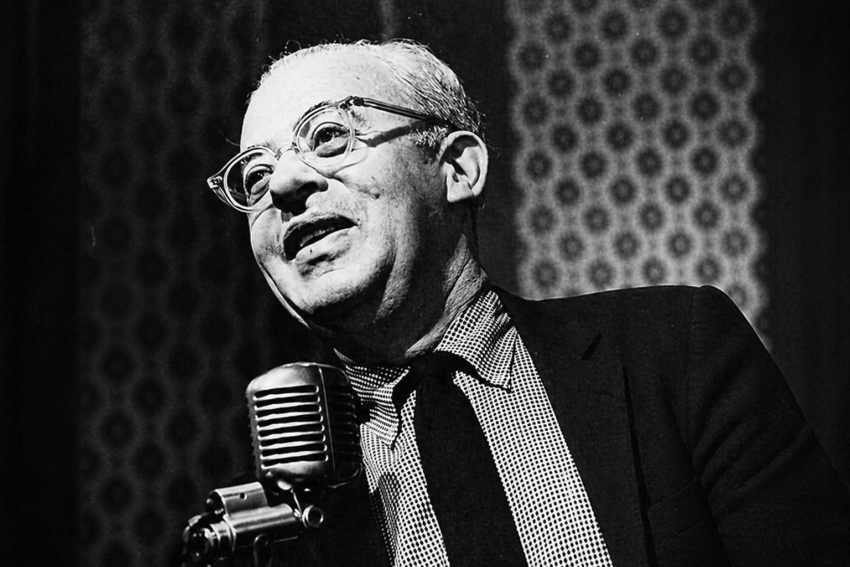
Saul Alinsky did not merely promote political activism—he advanced a method of organized conflict rooted in class struggle and power politics, fundamentally at odds with the constitutional vision of America’s Founders. Barack Obama rose from the same Chicago organizing tradition, while Hillary Clinton studied Alinsky’s ideas and acknowledged their early influence. His book, Rules for Radicals, is regarded by critics as a manual for agitation, subversion, and incremental revolution—a strategy not merely to protest the system, but to transform it. To those who cherish limited government, individual liberty, and the moral order that undergirds the Republic, Alinsky’s methods represent a warning: that free societies can be weakened not only from without, but from within. Here are some of his quotes:
“A Marxist begins with his prime truth that all evils are caused by the exploitation of the proletariat by the capitalists. From this, he logically proceeds to the revolution to end capitalism, then into the third stage of reorganization into a new social order of the dictatorship of the proletariat, and finally the last stage — the political paradise of communism.”
“The organizer’s first job is to create the issues or problems, and organizations must be based on many issues. The organizer must first rub raw the resentments of the people of the community; fan the latent hostilities of many of the people to the point of overt expression. He must search out controversy and issues, rather than avoid them, for unless there is controversy people are not concerned enough to act … An organizer must stir up dissatisfaction and discontent.”
“Make the enemy live up to its own book of rules. Force them to obey their own stated principles or standards. You can kill them with this, for they can no more obey their own rules than the Christian church can live up to Christianity.”
“Pick the target, freeze it, personalize it, and polarize it. Cut off the support network and isolate the target from sympathy. Go after people and not institutions; people hurt faster than institutions. (This is cruel, but very effective. Direct, personalized criticism and ridicule works.)
“Ridicule is man’s most potent weapon. There is no defense. It is almost impossible to counterattack ridicule. Also it infuriates the opposition, who then react to your advantage.”
“The major premise for tactics is the development of operations that will maintain a constant pressure upon the opposition. Tactics exist to keep the enemy off-balance and reactive.”
“Keep the pressure on. Never let up. Use different tactics, actions, and current events to maintain constant pressure so the opposition reacts on your terms.”
“No politician can sit on a hot issue if you make it hot enough.”
“Never go outside the experience of your people. When an action or tactic is outside the experience of the people, it results in confusion, fear, and retreat.”
“Whenever possible, go outside the experience of the enemy. Do the opposite to the opposition—unfamiliar actions create disorientation, anxiety, and mistakes on their side.”
“Any revolutionary change must be preceded by a passive, affirmative, non-challenging attitude toward change among the mass of our people. They must feel so frustrated, so defeated, so lost, so futureless in the prevailing system that they are willing to let go of the past and change the future. This acceptance is the reformation essential to any revolution.”
“One’s concern with the ethics of means and ends varies inversely with one’s personal interest in the issue (and with distance from the conflict).”
“The end is what you want and the means is how you get it.”
“In war, the end justifies almost any means.”
“They have the guns and therefore we are for peace and for reformation through the ballot. When we have the guns then it will be through the bullet.”
“The Prince was written by Machiavelli for the Haves on how to hold power. Rules for Radicals is written for the Have-Nots on how to take it away.”
“Lest we forget at least an over-the-shoulder acknowledgment to the very first radical: from all our legends, mythology, and history (and who is to know where mythology leaves off and history begins—or which is which), the first radical known to man who rebelled against the establishment and did it so effectively that he at least won his own kingdom—Lucifer.”
Originally posted 2026-04-28 15:21:50.